
THeory of Change
At the heart of Mosaic Environmental Fund’s work is the belief that the power to drive transformative change lies in the strength of our collective efforts.
Powering systems change
At a time when a majority of Americans are concerned about declining environmental quality and want more government action to protect it, bedrock policies and institutions are being rapidly dismantled with seeming impunity. This disconnect speaks volumes about both the challenges and opportunities before us in this critical decade, when our climate, ecosystems, and communities are under dire threat. It reminds us that without true power, rooted in civil society structures for people to engage and take action collectively and repeatedly, gains will always be fragile.
While the environmental movement has significant assets and potential to advance large-scale change, its ability to build and wield power across 30K+ organizations is hampered by fragmentation and silos, structural inequities that sideline key voices, and uneven distribution of skills and resources.
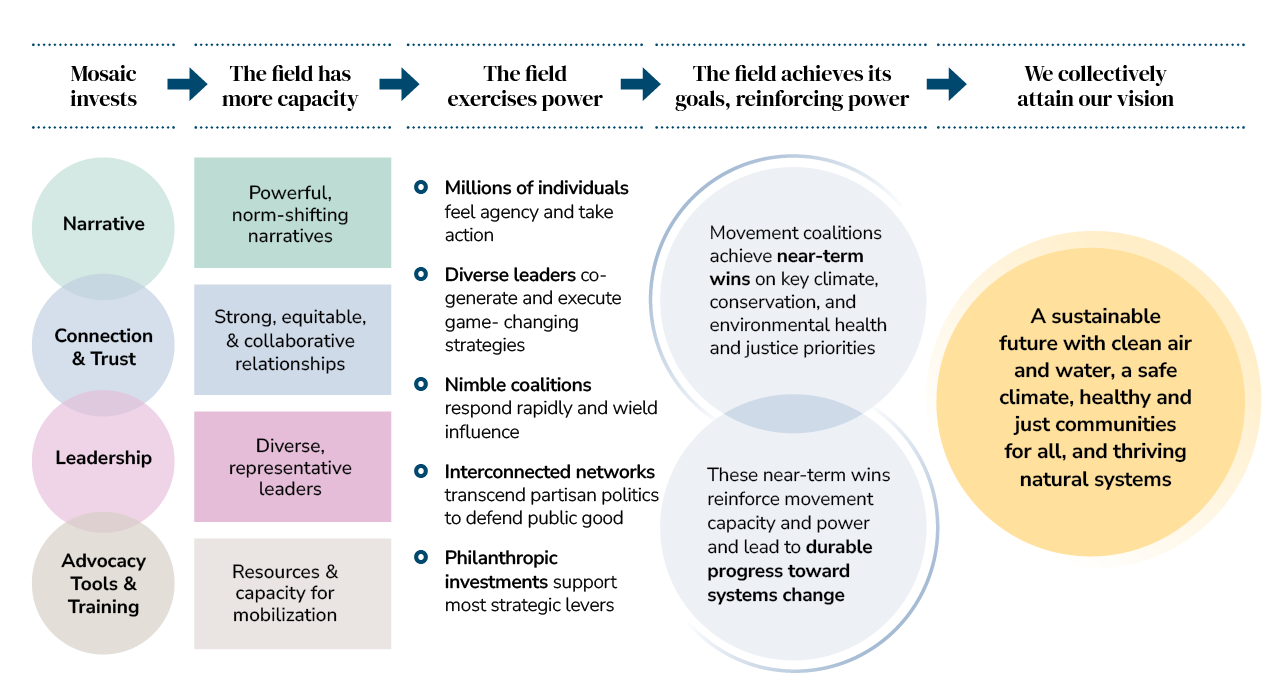
Mosaic’s work to build a more pluralistic, adaptive, and powerful movement zeros in on four interconnected pillars that leaders, academics, and funders recognize as the key underlying capacities for successful movements – what we call movement infrastructure: connection and trust that enables people to work together across difference toward shared aims; advocacy tools and trainings that help groups at all levels access data and mobilize constituents; systems and structures for developing and deploying compelling, culturally relevant narratives that shift hearts and minds and inspire action; and a deep bench of skilled leaders who represent the diversity of the movement.
Our theory of change recognizes that power is built fractally: As people convene and use their collective power to achieve near-term wins, their sense of agency is reinforced, driving more collaboration and ever larger wins, ultimately building to the scale and speed needed for transformational change.
Gratitude
Mosaic’s theory of change, adopted in 2024 by our Leadership Council, is informed by insights from grantees, members of our governing body and staff, leading academics, and our funder community, as well as data from grant reports, field surveys, research publications, and media. Our theory of change process was supported by learning and evaluation consultant Rhonda Schlangen, Onside Partners, and The Bridgespan Group.